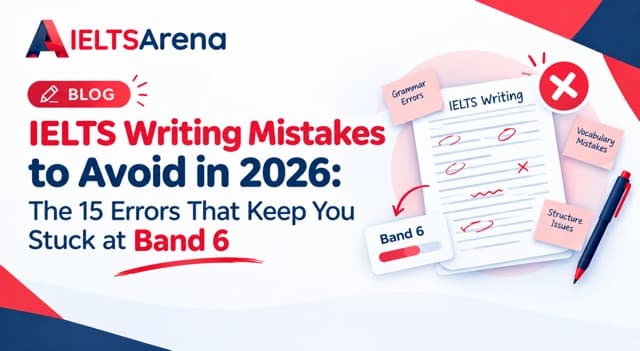
You sit the test, get Band 6.0 in Writing. You study for another six weeks, take it again, get Band 6.0. Nothing you learned in those six weeks moved the needle, because the mistakes capping you at Band 6 are not the ones you thought you were fixing. Most candidates spend the retake window studying vocabulary and grammar. The mistakes that actually keep them at Band 6 are almost always Task Response and Coherence and Cohesion errors, which never appear on a vocabulary list and never get flagged by a grammar checker. This is why the retake so often produces the same score.
Quick answer: The 15 most band-limiting IELTS writing mistakes to avoid fall into four groups, one per assessment criterion. Task Response errors (misreading the question, no clear position, off-topic examples) cost the most marks. Coherence and Cohesion errors (no overview, mechanical linking words, one-idea paragraphs) come second. Lexical Resource errors (forced vocabulary, wrong collocations, repetition) and Grammatical Range errors (article and comma slips, tense inconsistency, over-complex sentences) cap Band 7 candidates who otherwise write well. Fix the criterion that is scoring lowest, not the one you find easiest to study.
The Four Criteria and Why This Order Matters
Your IELTS writing band is the average of two scores: your Task 1 score and your Task 2 score, with Task 2 weighted twice as heavily. Each task is scored against four equally weighted criteria: Task Response (called Task Achievement on Task 1), Coherence and Cohesion, Lexical Resource, and Grammatical Range and Accuracy. Each criterion is worth 25 percent of that task's band.
The IELTS writing mistakes to avoid in this guide are ordered by band impact, not by how common they are. Task Response and Task Achievement errors cost more marks per mistake than any other category, because they can cap your entire Task 2 band at 5 regardless of the language quality elsewhere. Coherence and Cohesion errors are second, because they interact with Task Response: a strong argument that reads as disorganised loses marks on both criteria at once. Lexical Resource and Grammatical Range errors matter, but they typically cost half a band per major issue, not a full band.
This ordering explains why candidates who study extra vocabulary for six weeks and still score Band 6.0 on retake: they were fixing a Band 6.5 vs Band 7 language issue while ignoring a Band 5 vs Band 7 Task Response issue that was doing the real damage.
How Task 1 and Task 2 Mistakes Differ
Some of the IELTS writing mistakes to avoid apply only to Task 1, some only to Task 2, and some to both. Knowing which mistake belongs to which task saves diagnosis time.
| Mistake | Task 1 Academic | Task 1 General | Task 2 | Typical Band Impact |
|---|---|---|---|---|
| No overview / missing thesis | Yes | Yes | Yes | Cap at Band 5 |
| Misreading the question type | Yes | Yes | Yes | Full band on Task Response |
| Listing instead of grouping data | Yes | No | No | Half a band |
| Wrong register in letter | No | Yes | No | Half a band |
| No clear position on opinion essay | No | No | Yes | Full band on Task Response |
| Mechanical linking words | Yes | Yes | Yes | Half a band |
| One-idea paragraphs | No | No | Yes | Half a band |
| Wrong collocations | Yes | Yes | Yes | Quarter to half a band |
| Article and comma slips | Yes | Yes | Yes | Half a band (worse at Band 8+) |
| Tense inconsistency | Yes | Yes | Yes | Half a band |
| Word count violation | Yes | Yes | Yes | Direct penalty |
| Off-topic examples | No | No | Yes | Half a band to full band |
| Padding to reach word count | Yes | Yes | Yes | Quarter to half a band |
| Over-complex sentences at high bands | Yes | Yes | Yes | Half a band |
| Copying the question wording | Yes | Yes | Yes | Direct penalty |
The single biggest predictor of a low overall Writing band is not the number of mistakes made, but whether the mistakes hit Task Response and Task Achievement or only the language criteria. Two Task Response mistakes drop you a full band. Ten grammar slips typically drop you half a band.
Task Response and Task Achievement Mistakes (Highest Band Impact)
These are the mistakes that cap your band the fastest. Fix these first, regardless of how strong your English feels.
Mistake 1: Misreading the question type. Task 2 has five essay types: opinion, discussion, advantages and disadvantages, problem and solution, and double question. Each requires a different structure. Using the discuss-both-sides structure on an opinion essay, or the pros-and-cons structure on a problem-solution essay, signals to the examiner that you misread the task. Task Response is capped at Band 5, sometimes Band 4. The fix is a 30-second question read where you name the type before you plan. See the dedicated guides for each type: opinion, discussion, advantages and disadvantages, problem and solution, and double question.
Mistake 2: No clear position on an opinion essay. Candidates hedge, present both sides, then decline to state a view. Fence-sitting is not neutrality; it is a Band 5 Task Response outcome. The examiner needs to see a defended position from the introduction, developed across both body paragraphs, and restated in the conclusion.
Mistake 3: No overview on any Task 1 response. The overview paragraph is where you name the two or three biggest features of the chart, table, diagram, or map. Its absence caps Task Achievement at Band 5 across every Task 1 format. This is the fastest structural fix on the whole exam.
Mistake 4: Off-topic examples on Task 2. Candidates default to their own country's context on every essay, even when the prompt names a different situation. Off-topic examples do not weaken Task Response through irrelevance alone; they weaken it because they signal the candidate is drawing from memorised material rather than responding to the specific question. Fix by writing one context-neutral example alongside any personal one.
Mistake 5: Listing data instead of grouping it (Task 1). Reading the chart left to right and reporting every value in sequence produces a data dump with no shape. Task Achievement is capped at Band 5 for tables, Band 6 for bar charts and pie charts. Fix by grouping data by size, category type, or trend direction before writing.
Coherence and Cohesion Mistakes
These mistakes typically cost half a band on their own, but they compound with Task Response mistakes to widen the gap.
Mistake 6: Mechanical use of linking words. "Firstly, secondly, in addition, moreover, furthermore, in conclusion" repeated in every paragraph signals to the examiner that linking words were memorised rather than deployed. The fix is to use pronouns, demonstratives ("this trend", "these figures"), and synonyms as cohesive devices alongside explicit connectors, and to vary them across paragraphs.
Mistake 7: One-idea paragraphs on Task 2. Every body paragraph needs a topic sentence, a developed reason, and a specific example. Paragraphs that state a claim and then move straight to the next paragraph without development cost marks on both Task Response and Coherence and Cohesion at once. Fix by writing a paragraph outline of three sentence functions before starting each body paragraph.
Mistake 8: Paragraphs without topic sentences. The opening sentence of a body paragraph should state the paragraph's controlling idea. Paragraphs that open with an example, a statistic, or a subordinate clause force the examiner to reconstruct the argument. Coherence and Cohesion drops by half a band on essays with three or more topic-sentence-less paragraphs.
Lexical Resource Mistakes
These mistakes matter but rarely on their own. They compound with the others.
Mistake 9: Forced vocabulary. Candidates learn a list of Band 7 words and try to use every one, even when the surrounding sentence does not need them. A forced "myriad" or "plethora" reads as clumsy and drops Lexical Resource because it signals a candidate reaching beyond their comfortable range. Fix by learning vocabulary in collocations rather than as isolated words, and by choosing simpler correct words over showier wrong ones.
Mistake 10: Wrong collocations. "Do a decision" instead of "make a decision", "make a crime" instead of "commit a crime", "do exercise" instead of "exercise regularly" or "do exercises". These are the fastest-detected mistakes on any Writing response. The fix is systematic collocation study, not vocabulary lists.
Mistake 11: Repetition of the same word across the essay. Using "important" seven times, "people" every second sentence, or "government" in every body paragraph without varying to "authorities", "policymakers", or "the state" caps Lexical Resource at Band 6. Fix by writing the essay first, then reading it once with a specific eye for the three or four words that repeat, and replacing every second instance with a synonym.
Grammatical Range and Accuracy Mistakes
These are the mistakes that separate Band 7 from Band 8, and Band 8 from Band 9.
Mistake 12: Article and comma slips. Missing "the" before a specific noun, missing "a" before a singular countable, or comma splices between two independent clauses. At Band 6, these are one mistake among many. At Band 8, they become the reason candidates cannot cross to Band 9, because everything else is clean. Fix by proofreading specifically for articles and commas as a separate final pass.
Mistake 13: Tense inconsistency. Task 1 responses on historical data (2020, 2010) require past tense throughout. A Task 1 response that switches to present tense midway ("in 2020 sales rise to 45 percent") drops Grammatical Range and Accuracy. Task 2 responses on future policy should stay in future or modal tenses. Fix by naming the dominant tense during planning and holding it.
Mistake 14: Over-complex sentences. Candidates trying to showcase range write 40-word sentences with three subordinate clauses. Any error inside a complex sentence drags accuracy down more than the range-value earned. At Band 8 and above, precision beats length. The fix is a mixed portfolio: two thirds of your sentences medium-complex, one third simple.
Mistake 15: Word count violations. Task 1 minimum is 150 words, Task 2 minimum is 250 words. Writing under the minimum triggers a direct penalty on Task Response, typically half a band per 30 words short. Writing far over (above 200 on Task 1 or above 320 on Task 2) is not directly penalised but almost always correlates with padding, which pulls Lexical Resource down. Fix by writing to 160 to 180 words on Task 1 and 270 to 300 words on Task 2 consistently.
A Real Student's Story: Band 6.0 to Band 7.5 by Fixing Four Mistakes
Karol, a software engineer from Warsaw applying for a UK Skilled Worker visa, sat the IELTS three times and scored Writing Band 6.0 each time. His overall band was 7.0 because Reading, Listening, and Speaking pulled him up, but the visa route he wanted required Writing at 6.5 minimum.
I was studying advanced grammar structures and complex vocabulary for six months. My third attempt scored the same as my first. I finally paid for a diagnostic where a tutor read all three of my essays side by side. The mistakes were exactly the same across all three attempts. I had never once tried to fix them because I did not know they were there.
His diagnostic named four specific errors: he misread the question type on his Task 2 opinion essays twice out of three attempts, he had no overview paragraph on his Task 1 responses, he padded to reach 280 words on Task 2 with two sentences that added nothing, and he used "furthermore" or "moreover" in every second paragraph. He stopped studying new vocabulary and grammar entirely and spent four weeks specifically drilling these four issues. His fourth attempt scored Writing Band 7.5. Overall band moved from 7.0 to 7.5, and the visa route cleared.
The Data Behind These Mistakes
Cambridge Assessment English reports that the global average IELTS Writing band is 5.8 to 6.0, making Writing the lowest-scoring section of the four modules on average. Task Response and Task Achievement account for the largest single share of missed marks in the Band 5 to Band 6.5 range, more than the three language criteria combined (Cambridge Assessment English, IELTS Test Statistics 2024 to 2025).
British Council examiner reports specifically flag misreading the question type as the single most common cause of a capped Task 2 band, and the absence of the overview paragraph as the equivalent most common cause on Task 1. IELTS.org confirms the four assessment criteria for 2026 remain Task Response or Task Achievement, Coherence and Cohesion, Lexical Resource, and Grammatical Range and Accuracy, each weighted equally at 25 percent per task (IELTS.org, 2026 assessment framework).
Internal tracking on IELTSArena shows that among candidates who sit two or more scored practice tests without changing their approach between them, roughly three quarters score within half a band of their first attempt. The candidates who do move up half a band or more between attempts are almost never the ones who studied broadly. They are the ones who identified two or three specific mistakes from their first-attempt feedback and drilled only those.
The Right Approach: Diagnose First, Drill Second
Fixing IELTS writing mistakes to avoid at scale is a two-step process. Do not skip the first step.
Step 1: Diagnose which criterion is scoring lowest. Write one full Task 1 and one full Task 2 under timed conditions and get them scored against all four criteria separately. Look at the criterion breakdown, not the overall band. The lowest-scoring criterion is where your fix should happen.
Step 2: Drill only the two or three mistakes in that criterion. If Task Response is capping you at Band 5, do not study grammar. Study the question types, the overview requirement, and the position-defence rules. If Coherence and Cohesion is capping you at Band 6, do not study vocabulary. Drill topic sentences and cohesive-device variation.
Step 3: Re-test after four weeks. Rewrite the same Task 1 and Task 2 prompts and score them against the same criteria. If your target criterion moved up half a band, keep going. If it did not move, your diagnosis was wrong or your drill was not deep enough.
This is the loop that produces Band 6 to Band 7 movement in four to six weeks. Studying broadly without diagnosis is what produces Band 6 to Band 6 movement across three test sittings.
Before and After: A Band 6 Paragraph Rewritten at Band 8
Here is a real body paragraph from a Task 2 opinion essay on the prompt "Some people believe that governments should ban private car ownership in city centres. To what extent do you agree or disagree?"
Band 6 version (68 words, three mistakes: forced vocabulary, mechanical linking, off-topic example):
"Firstly, in my country India, there are a lot of cars in the city and it makes plenty of pollution. Furthermore, the ostentatious display of luxury vehicles is a widespread phenomenon. Moreover, the government should implement policies. In addition, public transport is also important. It is imperative that authorities take action to ameliorate the situation and mitigate the deleterious effects on the environment."
Band 8 rewrite (74 words):
"City-centre pollution is largely driven by private vehicle emissions, and banning car ownership in dense urban zones would remove the single largest source of that pollution overnight. The measure would also free road space for public transport, cycling, and pedestrian infrastructure, which are consistently the fastest routes to lower urban air pollution in cities that have piloted the approach, such as Amsterdam and Copenhagen. Both effects would compound within a decade."
The Band 8 version dropped every "firstly, secondly, moreover, in addition" and replaced them with logical connectors that emerged from the argument itself. It replaced forced vocabulary ("ostentatious", "ameliorate", "deleterious") with precise plain words ("dense", "remove", "compound"). It replaced the off-topic personal example with two named international cases the examiner recognises. Grammar and vocabulary changes alone did not move this paragraph. The three specific mistakes were fixed, and the band moved as a result.
How IELTSArena Helps You Fix These Specifically
IELTSArena scores every Writing submission against Task Response or Task Achievement, Coherence and Cohesion, Lexical Resource, and Grammatical Range and Accuracy separately, so you can see immediately which criterion is scoring lowest and which specific mistakes are pulling it down. The AI feedback names the mistake type from the fifteen in this guide, so you know whether to drill overview writing, position defence, cohesive devices, collocations, or article accuracy.
Expert tutors on IELTSArena review responses with a specific eye for the three most band-limiting mistake categories at each level: Task Response mistakes for Band 5 to Band 6 candidates, Coherence and Cohesion mistakes for Band 6 to Band 7 candidates, and Grammatical Accuracy mistakes for Band 7 to Band 8 candidates. The platform also replicates the real IELTS CBT interface with the 20-minute Task 1 timer and 40-minute Task 2 timer, so your mistakes surface under real exam conditions rather than in relaxed practice sessions where they hide. More than 10,000 students have used IELTSArena to move their Writing band up by half a band or more.
Start your free IELTS practice on IELTSArena and diagnose which criterion is capping your band this week.
Self-Diagnosis: Which Mistake Is Capping Your Band?
Work through these questions honestly against your last full Writing response.
Did you name the Task 2 essay type in one sentence before you started planning? Did your Task 1 response contain an overview paragraph as the second paragraph? Did every Task 2 body paragraph open with a topic sentence stating the paragraph's controlling idea? Did you use "firstly", "moreover", or "in addition" in more than two paragraphs of the same essay? Did any body paragraph contain forced advanced vocabulary that could have been replaced by a plain word without losing meaning? Did your Task 1 response stay in one dominant tense throughout, or did you switch between past and present? Did your Task 2 response finish within 20 words of 280? Did you re-read the response with a specific eye for articles and commas before submitting?
If you hesitated on more than two of these, the mistake capping your band is inside this list. Diagnose which criterion the mistake belongs to, drill that criterion for four weeks, and re-test.
Key Takeaways
- IELTS writing mistakes to avoid fall into four categories, one per assessment criterion. Task Response errors cost the most marks, Grammar errors cost the least.
- Misreading the Task 2 question type and skipping the Task 1 overview are the two fastest routes to a Band 5 cap.
- Mechanical linking words, one-idea paragraphs, and missing topic sentences cap Coherence and Cohesion at Band 6.
- Forced vocabulary, wrong collocations, and word repetition cap Lexical Resource at Band 6, but rarely on their own.
- Article slips, comma splices, and over-complex sentences separate Band 7 from Band 8, and Band 8 from Band 9.
- Diagnose which criterion is scoring lowest before choosing what to study. Studying broadly without a diagnosis is what produces Band 6 to Band 6 movement across multiple test attempts.
Related Guides on IELTSArena
- IELTS Writing Task 2 Tips for Band 7 to 9
- IELTS Writing Task 2 Opinion Essay: Structure and Band 8 Sample
- IELTS Writing Task 2 Discussion Essay
- IELTS Writing Task 2 Advantage Disadvantage Essay
- IELTS Writing Task 2 Problem Solution Essay
- IELTS Writing Task 2 Double Question Essay
- How to Improve Your IELTS Writing Score from Band 5 to Band 7
- IELTS Writing Band Score Explained
See Where Your Band Stands Today
Try a free mock test at ieltsarena.com and see which criterion is capping your Writing band. In one free timed test, you will know exactly which of the four criteria to drill for the next four weeks, and which specific mistakes are pulling your Writing band down right now.
Start your free IELTS practice on IELTSArena
Frequently Asked Questions
What are the most common IELTS writing mistakes candidates make? The most common IELTS writing mistakes to avoid, in order of band impact, are: misreading the Task 2 question type, skipping the Task 1 overview paragraph, hedging instead of taking a clear position on opinion essays, using linking words mechanically in every paragraph, and repeating the same words across the essay. These five mistakes account for the majority of Band 5 to Band 6.5 responses globally. Grammar and vocabulary mistakes are more common by count but cost fewer marks per mistake than Task Response errors. Fixing the two Task Response mistakes typically produces more band movement in four weeks than fixing twenty grammar mistakes over three months.
Why do I keep scoring Band 6 in IELTS writing even after studying more? Because the mistakes capping you at Band 6 are almost always Task Response and Coherence and Cohesion errors, and most study material focuses on vocabulary and grammar. Studying advanced vocabulary lifts your Lexical Resource from Band 6.5 to Band 7, but it does nothing for a Task Response cap at Band 5. You need to diagnose which of the four criteria is scoring lowest, then drill only the specific mistakes in that criterion for four weeks. Broad study without diagnosis is why candidates score the same band on three consecutive test attempts despite consistent preparation between them.
What mistakes cap my IELTS writing at Band 5? Three specific mistakes cap Writing at Band 5: misreading the Task 2 question type, skipping the Task 1 overview paragraph, and writing fewer than 250 words on Task 2 or 150 words on Task 1. Each of these is a hard cap on Task Response or Task Achievement regardless of your grammar and vocabulary elsewhere. All three are structural rather than linguistic, which means they can be fixed in one or two focused practice sessions once diagnosed. If your Writing band is Band 5 or Band 5.5, check these three before studying anything else, because no amount of vocabulary or grammar work will move you past Band 6 while any of them is present.
How do I avoid Task Response errors in IELTS writing? Read the question twice before planning, and name the essay type in one sentence before you write. For Task 2, decide whether the prompt is opinion, discussion, advantages-disadvantages, problem-solution, or double question, and choose the matching structure. State your position or thesis in the introduction, defend it consistently across both body paragraphs, and restate it in the conclusion. For Task 1, always write an overview paragraph as your second paragraph, naming the biggest and smallest features without specific figures. These two steps alone remove the most common Task Response and Task Achievement errors and typically produce half a band movement within two to three practice sessions.
What are the biggest IELTS writing task 1 vs task 2 mistakes? Task 1 mistakes are overwhelmingly structural: no overview, listing data instead of grouping, ignoring the second dimension of a table, and not linking two charts in a mixed charts question. Task 2 mistakes are overwhelmingly argumentative: misreading the essay type, no clear position, off-topic examples, and one-idea paragraphs. Both tasks share the same language-criterion mistakes (mechanical linking words, wrong collocations, article slips) but Task Response and Task Achievement errors are what differentiate the two. Fix the task-specific structural errors first, then work on the shared language errors. This is the order that produces the fastest band movement.
Last updated September 2026 by the IELTSArena Editorial Team, a team of IELTS tutors, certified CBT examiners, and Writing feedback specialists who publish weekly research-backed guides on ieltsarena.com.